

White Sage (Salvia apiana): Uses, Meaning, and Energy Cleansing
25.01.2017
What Is California White Sage (Salvia apiana) and Where Does It Grow?
White sage (Salvia apiana, also known as white sage) is an herb best known for its aromatic smoke with powerful cleansing properties. It grows in dry and hot desert areas along the Californian coastal mountain ranges. It is a perennial plant with long, white-gray-green leaves and white flowers. The plant holds an important place in many traditions around the world, especially among Native American peoples.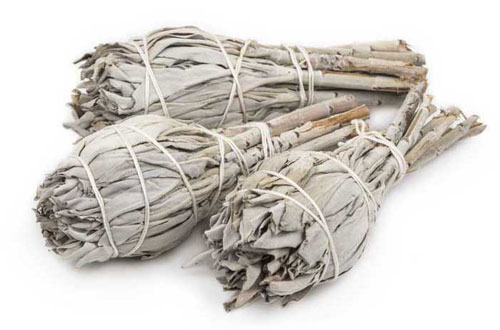
Uses of White Sage Around the World
White sage has been used for centuries in various cultures around the world for different purposes. Smudging with white sage is believed to cleanse negative energies from a space and raise vibrations. In addition, white sage incense is often used before ceremonies, meditation, during preparations for important events, or to boost energy. Through the ritual of burning white sage and other incense, the mind, body, and spirit are symbolically cleansed.
Traditional Use of White Sage Among Native North American Peoples
Due to its wide range of beneficial effects, white sage has long been considered sacred among Native Americans. White sage has a rich tradition of use among Indigenous peoples of North America, especially among tribes such as the Navajo, Apache, and others. It is used for various purposes, including space cleansing, removing negative energies, preparation for important ceremonies, healing, and connecting with the spiritual world. Rituals involving white sage were and still are an important part of their culture and spiritual practices.
White sage requires sufficient airflow when burned. Native American tribes traditionally use bird feathers for this purpose. The smoke represents prayers rising into the cosmos, which is why prayers are spoken during the burning ritual. In Native American ceremonies, attention is given to the energies of the four cardinal directions (north, south, east, west), represented by four powerful animal spirit guides: the white buffalo, coyote, eagle, and grizzly bear. These are also connected to the four elements: earth, water, fire, and air.
North – Spirit of the White Buffalo: grounds, protects, and provides knowledge of life and death. Governs the element of earth.
South – Spirit of the Coyote: represents a sharp and quick mind, governs emotions, and is connected to the element of water.
East – Spirit of the Eagle: symbolizes inspiration, vision, protection, and purification, and governs the element of air.
West – Spirit of the Grizzly Bear: represents strength, determination, vitality, and cleansing, and governs the element of fire.
Effects of White Sage Smoke
The most important effect of white sage is energetic cleansing. It is also believed to bring protection, mental clarity, a sense of peace, and harmony.
White Sage Incense in Modern Life
There is a growing interest in natural incense and the use of white sage, especially among spiritually aware individuals seeking natural ways to cleanse the aura, spaces, and objects.
When Is the Use of White Sage Incense Recommended?
Incense is used to cleanse energy. Regular use of white sage incense may contribute to a greater sense of clarity and support personal growth. It is important to take care of cleansing both ourselves and our surroundings. Ancient cultures believed that negative forces cannot enter a space filled with sage smoke.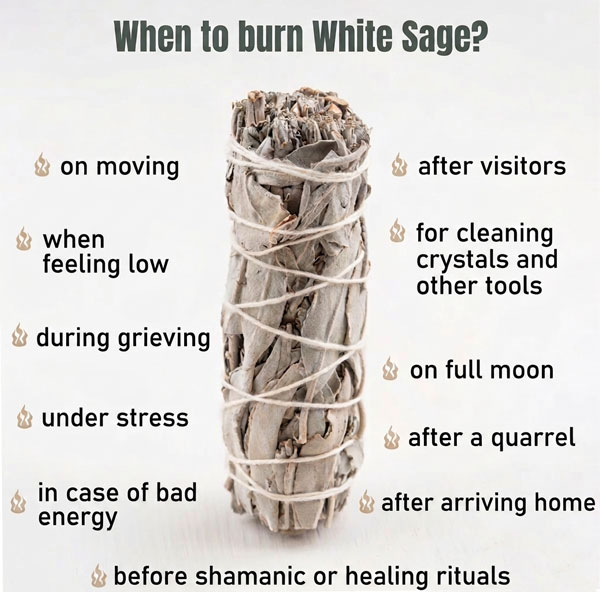
So, when should white sage incense be used?
Whenever we feel the need to cleanse energy—our own or that of our environment—especially on the following occasions:
- cleansing the energy of a space (home, workplace, car...)
- before meditation or as part of a spiritual practice
- before moving to a new place
- after an argument
- during times of grief
- after attending large gatherings or crowds
- during periods of low energy or discomfort
- during the full moon
- during stress
- cleansing the aura
- cleansing crystals, jewelry, and other objects
- after energetically demanding situations
- before energy healing sessions and shamanic rituals, etc.
Precautions When Using White Sage Incense
When using white sage incense, it is important to follow certain safety precautions. Always handle fire carefully and respectfully, and never leave burning incense unattended or near children. Place the burning sage in a fireproof bowl or shell on a stable surface, away from flammable materials. Ventilate the space well after use; some people prefer to keep windows open during smudging.
How to Use White Sage Incense
Preparation: Light the tip of the white sage using a match or candle and allow it to catch fire.
Extinguish the flame: Once it burns well, gently blow out the flame or wave the bundle through the air so it begins to smolder. The smoke should be steady but not too thick.
Smudge the space: Walk through the area you wish to cleanse or bless with the smoking sage bundle or loose leaves in a fireproof container. Use your hand or a feather to spread the smoke in all directions, paying special attention to corners, windows, doors, and other areas you wish to cleanse.
Set your intention: During the ritual, visualize or state your intention, such as clearing negativity, attracting positive energy, or blessing the space.
When finished, place the sage in a fireproof bowl or shell and allow it to extinguish completely. You may also extinguish it in water or sand (then dry and store the remaining sage for later use). Be cautious, as the container may remain hot.
Explore our selection of white sage, available in various bundle sizes or combined with other herbs. White sage is also available as loose leaves or small branches.
Frequently Asked Questions About White Sage
Is white sage suitable for everyone?
White sage is a natural incense; however, it is recommended to use it in moderation and to ensure proper ventilation of the space after use.
This article is for informational purposes only and is based on personal experience and the experiences of users.
 Stay Connected