

Save 36%
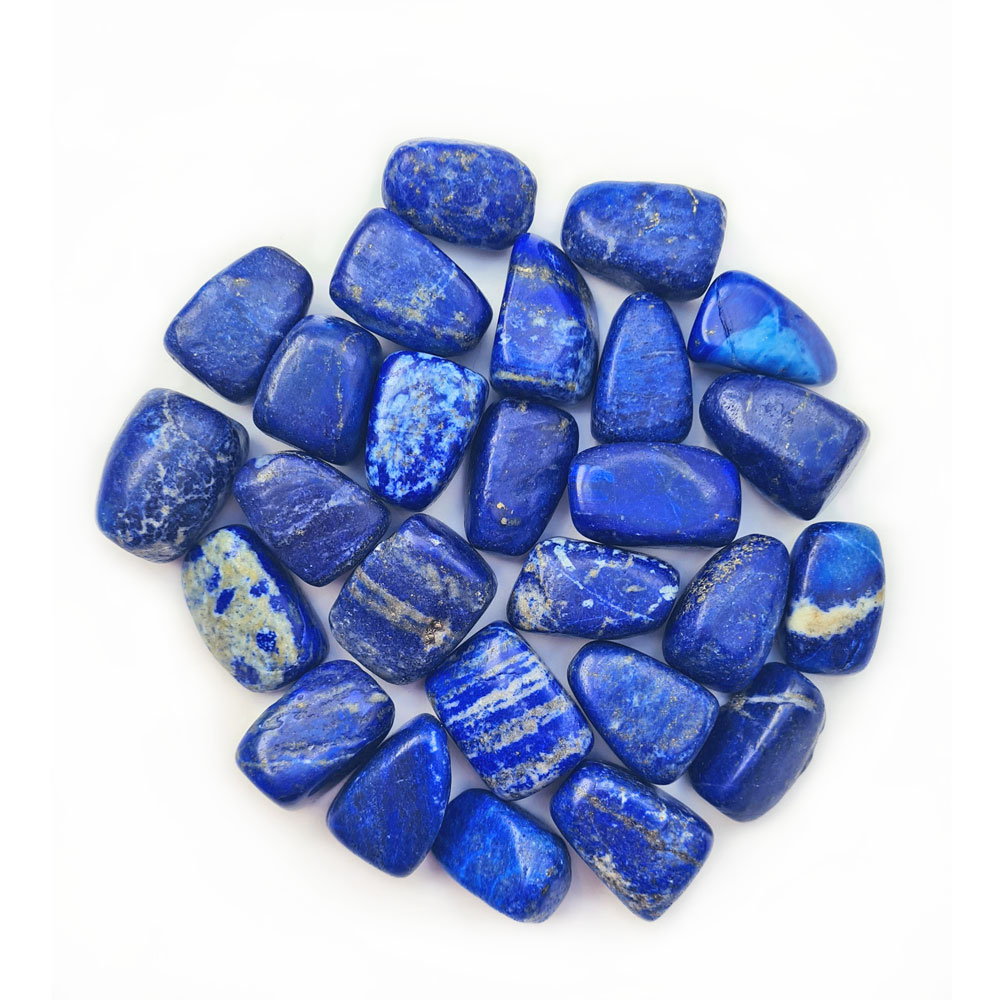

Few crystals have such a rich history as lapis lazuli. Its characteristic deep blue color, interspersed with tiny golden inclusions of pyrite, has fascinated kings, artists, and spiritual seekers for millennia. The ancient Egyptians revered it as a symbol of wisdom, truth, and inner strength, and today it remains one of the most recognized crystals for meditation, personal growth, and developing intuition. Selected specimens captivate with their intense blueness and distinct natural pattern, making each stone unique.
Stone Details
- Stone: Lapis lazuli
- Quality: Grade A quality
- Color: Intense blue with golden pyrite inclusions and white calcite matrix
- Chakras: Throat (Vishuddha), Third Eye (Ajna)
- Element: Water
- Planet: -
- Zodiac Signs: Taurus, Sagittarius
- Keywords: Wisdom, intuition, clarity of thought, communication, inner peace, creativity, self-awareness, protection, personal growth
Geological and Mineral Characteristics of Lapis Lazuli
Lapis lazuli is not an individual mineral, but a metamorphic rock composed mainly of lazurite, which gives it its characteristic blue color. In addition, it contains pyrite, which creates the distinctive golden sparkling inclusions, as well as calcite and sodalite. The hardness of the stone ranges from 5 to 5.5 on the Mohs scale. Since it is a natural stone, each specimen is slightly different – varying in the shade of blue, the distribution of golden inclusions, and the white patterns of calcite.
Metaphysical Properties: Wisdom, Intuition, and Clear Communication
In crystal healing, lapis lazuli is traditionally considered a stone of wisdom, truth, and inner insight. It is often associated with developing intuition, clearer thinking, and the honest expression of thoughts and feelings. It is connected to the throat chakra, where it symbolically supports communication and expression, and to the third eye, which is linked to intuition and broader understanding. Many use it during meditation or as a support for personal growth, as it is said to help create a sense of inner peace, balance, and greater self-confidence.
Versatile Ways to Use it in Everyday Life
- Daily use: Carry the stone with you as a symbol of wisdom, self-confidence, and clear expression.
- Meditation: During meditation, place it on the area of the third eye or the throat chakra, where it is traditionally used to deepen intuition and calm thoughts.
- Home or workspace: Place it in a room where you want to encourage creativity, open communication, and a pleasant atmosphere.
- Personal growth: Lapis lazuli is a popular companion for learning, creative work, and developing inner wisdom.
Lapis Lazuli in Ancient Cultures
Lapis lazuli is known as one of the most revered and sacred stones of the ancient world. Cultures used it for ritual, protective, and royal purposes:
- Ancient Egypt: It was considered a stone of divinity, the night sky, and rebirth. Egyptians carved Eye of Horus amulets and heart scarabs for burial rituals from it, and used its powder as ritual makeup. They associated it with the soul of the gods Ra and Osiris.
- Mesopotamia and Sumer: Associated with the goddess Inanna (Ishtar), it was believed to contain divine life force. It was used for cylinder seals and protective amulets against curses.
- Tibet and India: Connected with the Medicine Buddha (Bhaisajyaguru). In Tibetan Buddhism, it was used in meditation to open the third eye, clear the mind, and dispel negative influences.
- Ancient Greece and Rome: It served as an amulet for protection against the evil eye (malocchio) and as a symbol of social power and royal authority.
Proper Care and Cleansing of Lapis Lazuli
Lapis lazuli is somewhat softer than quartz, so it requires gentler handling. Do not use aggressive chemicals or detergents for cleaning, and do not leave it in salt water for too long. You can read more about the different methods of physical and energetic cleansing in our blog post on cleansing crystals. After energetic cleansing, many charge the stone with a new intention by holding it in their hands for a few moments and focusing on their purpose or visualizing it surrounded by pure white light.
Since it is a natural stone, individual specimens vary in shape, shades of blue, and the distribution of golden pyrite inclusions and white calcite patterns. It is precisely these natural characteristics that make each stone unique.
No reviews found
 Stay Connected